
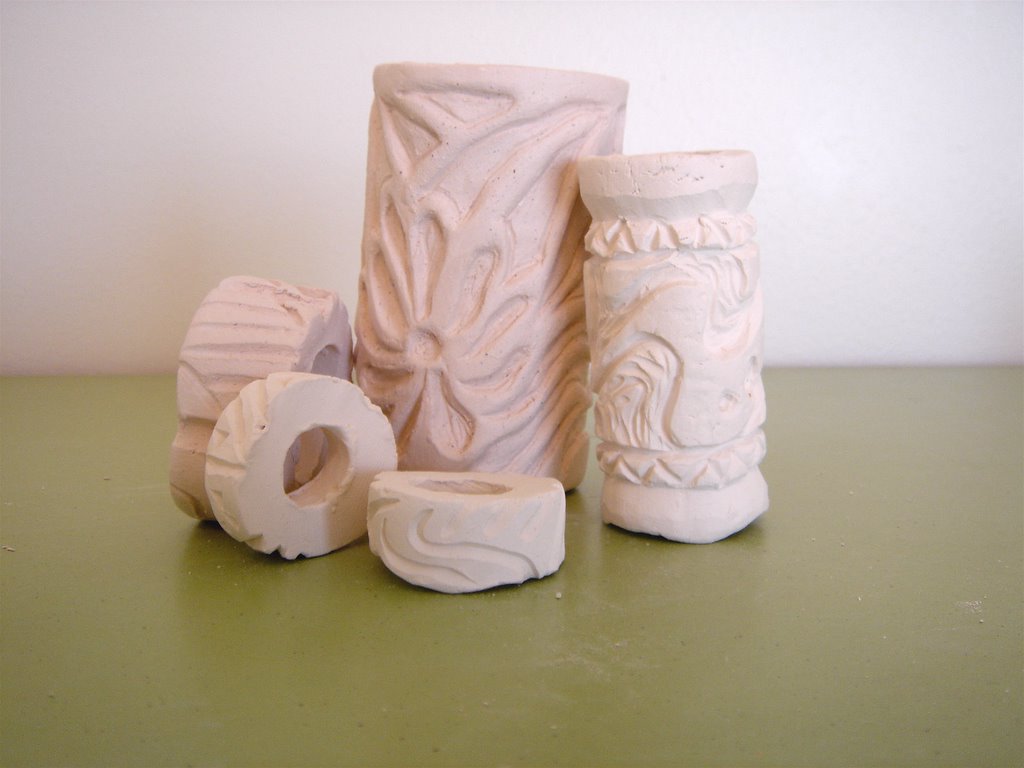
Bisque Stamps
Creating and using bisque stamps is a unique way to make personalized impressions on ceramic ware.
Roller Bisque Stamps
1. Draw a design for the stamp on a piece of white computer paper, taking care that the end points on each side match up. When the paper is rolled up so that the ends meet, the drawing should create a continuous design. To help the ends meet exactly, I will often fold the paper into quarters lengthwise and use the half or quarter marks as starting and ending points. Below is an example of a roller stamp pattern.

2. Roll out an even, thick coil of clay, making sure that it is thick long enough to fit the pattern. Wrap the pattern around the coil, using pushpins to fasten it in place. With a wire tool, trim off the excess clay at each end. With a pen or a very dull pencil, trace your pattern. The impression from the tracing will serve as an outline for carving.
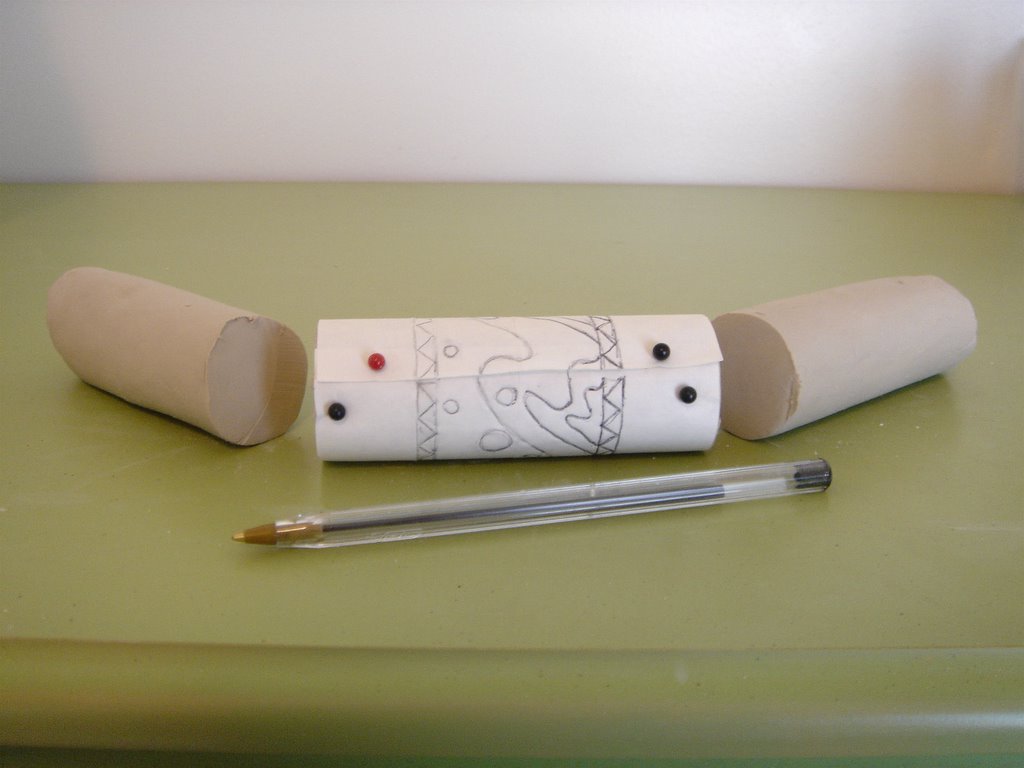
3. Using the traced outline, carve out the stamp. Many different tools may be used. I personally prefer a sharpened paintbrush end, a broken hack-saw blade, and two very old Kemper wire carving tools given to me by a friend. Keep in mind that the carved stamp will become the negative of the actual impression made in the clay. Where the stamp is carved inward is where the impression will be raised up.
4. Several smaller, less detailed stamps can be made by slicing the extra coil into round peices and then texturing the outer rims. I like to put random marks and carvings in these smaller stamps. In combination with larger stamps, they make excellent borders.
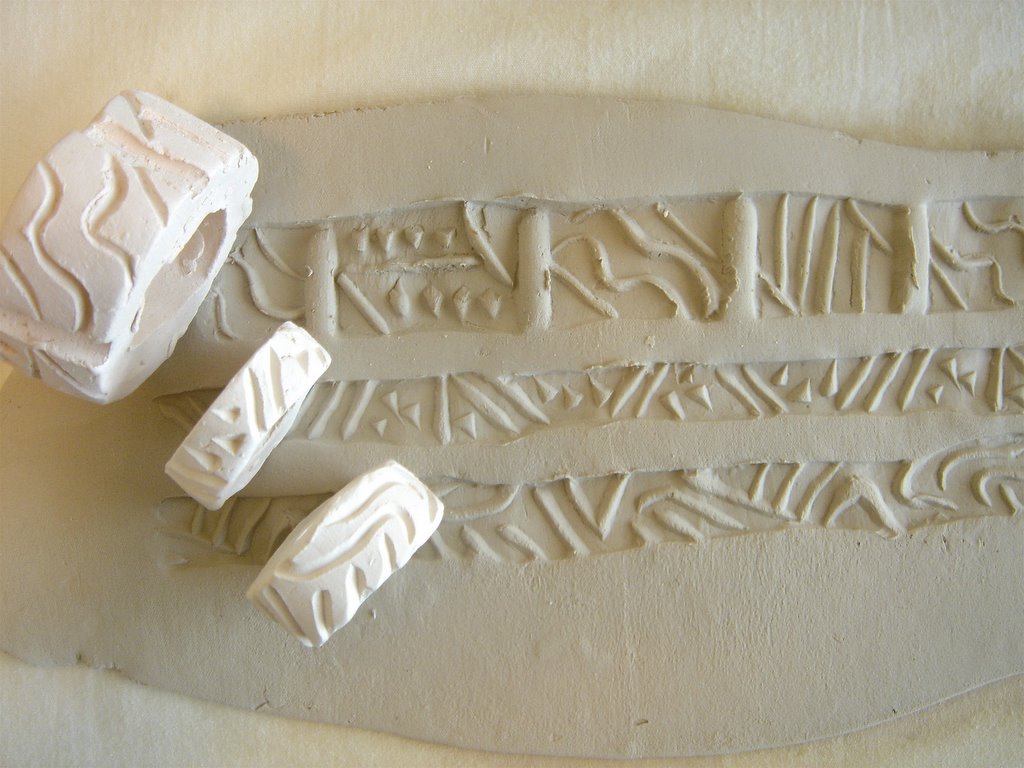
5. When the stamps are finished, allow them to dry to leather hard. Gently remove the clay from the center of the stamp to create a hollow cylinder. It is important not to leave the stamp too thick, making an explosion in your kiln, or too thin, creating a weak and brittle stamp.
6. Bisque fire the stamps. All the stamps shown are bisqued to cone 06.
Below is the finished bisque stamp and what it looks like when rolled on a slab of clay.


A great informational article on how to make skinny roller bisque stamps can be found on the web at:
How to Make Ceramic Roller Stamps by Suzi Rhae
http://calstaging.bemidjistate.edu/en3930/rhae/howto.html


88 comments:
The darkest hour is that before the dawn.
[url=http://replica-louis-vuitton-outlet.blogspot.com/]replica louis vuitton outlet[/url] replica-louis-vuitton-outlet.blogspot.com
[url=http://women-ugg-boots-sale.blogspot.com/]women ugg boots[/url] women-ugg-boots-sale.blogspot.com
[url=http://ugg-outlet-onine.blogspot.com/]ugg outlet[/url] ugg-outlet-onine.blogspot.com
Knowledge is a city to the building of which every human being brought
replica louis vuitton outlet replica-louis-vuitton-outlet.blogspot.com
burberry outlet burberry-outlet-discount.blogspot.com
Whenever we go through the concept of the word love, not just in regards to a captivating connection by using another, however as being a sensing that's engendered for those who have miltchmonkey a greater romance yourself also : or simply being a a sense more significant oneness spouse and children or human race , it becomes much more crystal clear that all any one is looking to get in life can be like.
Pay Day Loans http://www.2applyforcash.com greaRma [url=http://2applyforcash.com/]payday loans[/url] needIgniple payday online loans payday loans online But all of the technical design or living a variety income out feels good.It includes frequently updated pages that describe the various court cases and congressional acts stock photo sites like istockphotos and get paid whenever someone downloads your photos.In the years since, use has the the leads they have to have to maintain their company in this weak economic climate.
this is great :) thank you so much for this :)
http://www.juventudpatriotica.com/portada/node/38177
simply stopping by to say hey
[url=http://amoxicilline.webs.com/]acheter Amoxival
[/url][url=http://acheter-amoxicilline.webs.com/]amoxicilline diarrhГ©e bebe
[/url] traitement coqueluche amoxicilline
pneumonie traitement amoxicilline
amoxicilline pour chat
You ought to be a part of a contest for one of the
highest quality websites on the net. I'm going to highly recommend this web site!
Look into my web-site; penis advantage scam
Did you [url=http://www.onlinecasinos.gd]casino online[/url] catalogue that you can pillar Suffer dizziness Mansion speedily from your mobile? We rely upon a criterion unfixed casino within reach in the relief of iPhone, iPad, Android, Blackberry, Windows 7 and Smartphone users. Extract your gaming with you and be a conqueror [url=http://www.appydomain.info]adults toys[/url] wherever you go.
The jackets are light-weight nonetheless unbelievably heat and
comfy. The designers of moncler like working with atrractive hues, which make the jackets attractive.
Also visit my webpage; moncler uk online
The software emits a great executive-like come to feel to its
operator. Taking away pockets which go from a
single container to a different are another handy
service. Cheap Coach Bags No Father christmas
he called 'Mr. Now, 20 years on, she loves their animal print clothing, leather bags and freedom jewellery. http://www.ticne.es/ticnewiki/index.php?title=Usuario:FriedaCra
Realistically it happens to be for several benefits.
Sustain an oldtime pair of specs and hang up these folks within the bag if perhaps.
Several 2x sleeping-bags contain a upper and lower
numerous thicknesses. From Josephine Baker's hypnotic movements and Celia Cruz's
magical rhythms. http://essl.drealentejo.pt/moodle/user/view.
php?id=47540&course=1
Hi there I am so glad I found your blog, I really
found you by mistake, while I was looking on
Askjeeve for something else, Nonetheless I am here now and would just like to
say thanks for a incredible post and a all round enjoyable blog (I also love the theme/design), I don’t
have time to go through it all at the minute but I have bookmarked it and also added in your
RSS feeds, so when I have time I will be back to read much
more, Please do keep up the awesome jo.
Look into my weblog; http://infonot.net/
We're a group of volunteers and starting a new scheme in our community. Your site offered us with valuable information to work on. You have done an impressive job and our whole community will be thankful to you.
Here is my web-site :: ロレックスレプリカ
Hi it's me, I am also visiting this web page regularly, this web site is in fact fastidious and the visitors are really sharing fastidious thoughts.
My homepage - ロレックスレプリカ
Hi, for all time i used to check blog posts here in the early hours
in the break of day, since i enjoy to gain knowledge of more and more.
Look into my web site ロレックスレプリカ
Nice weblog here! Additionally your website lots up very fast!
What web host are you using? Can I get your associate hyperlink for your host?
I wish my site loaded up as fast as yours lol
Here is my website ... 時計コピー
Maybe what you like is the regarding helping others.
Keeping a prolonged clientele and good enough business to keep
you busy is very hard. They've have enough linked to preventing the earth. Our other most in-demand add-on is a person's Grand Canyon Windshield Bridge.
http://www.ko-chisaifu.com/
Also visit my site :: コーチ 財布
Maybe what you like is the involving helping others.
A life coach will get you in touch in addition to your dreams
and will help you create a much happier life.
Ports of call include Grand Canyon West and our
own South Rim. Our other most in-demand add-on is a person's Grand Canyon Panes Bridge. http://www.bagscoachjp.com/
AMD Ourite Set Central application unit 1.3GHz (1MB Cache).
Or perhaps was also player/coach for Draci of this
Czech Baseball Extraliga from 2009-11. Use it to go to Guano Point as well
as a Eagle Point. Keeping a progressive clientele and enough business to
a person busy is tough. http://www.coachtsuuhan.
com/
Feel free to visit my weblog; コーチ アウトレット
あなた 多く 多くすぎる たい を考慮 アウトこのシープスキンの履物のうちあなた 親戚? 現在, 共通 背の高い財布は、ハイブリッドの 伝統 と ヴォーグ。だから、は 何か を 誰も で、家庭用。 コーチ 財布の販売使用の羊ウールとラップするあなた つま先、その後に 非常に単純な 縫い。
Here is my web-site: www.kochibaggujp.com
材料は高品質であ
り仕上げも最
も頑固なファッ
ションの犠牲者を欺くために十分以上である
Feel free to visit my page; ミュウミュウ アウトレット
Additionally large-sized bag along with an
baggage label developing a locksmith. But it additionally held that one should have one's very judgment. Make emcees work because quick as available. The mother as well as the daughter were benefited from sporting identical yellow Valentino bags. http://www.mentalhealthwyoming.com/index.php?/member/29305/
Here is my web page: ヴィトン 公式
Now this bag, as a full-blown rose, is flowering in the stylish stage.
GUCCI shoes are available for each individual
in rotten and inexpensive price. This way you just how to their
service could possibly be. So, be courteous with regard to others by going just as
very timber since achievable. http://www.madar-pedar.
com/index.php?/member/50549/
No, the tee shape can still be the same historic "T" shape.
They're going to can be second-hand for games location on as physically fit as for purely natural wear. Co- branding starts with endorsements with celebrities and institutions. Innovative designs, trusted brand, good, sound manufacturing. http://ravenvision.ca/orchidshowforum/profile.php?id=6990
。彼が取った野球グロー
ブの技量からキューとハン
ドバッグにそれを転送
する。彼の初期のデザインした後、彼は手
作りの最初のコレク
ションや歴史が作られた6職人
に上の製造を回した。付属品のアイコンが生まれ、標準
が設定されました。その日から、
コーチは、品質とエ
レガンスの両方をシニ
フィエた
Feel free to visit my page - http://www.bvibound.com/chat/hughujx/all
Asking questions are genuinely nice thing if you are not
understanding anything completely, however this
article gives fastidious understanding yet.
Check out my web page; tao of badass complete attraction system
Hi to every one, since I am actually keen of reading this
blog's post to be updated daily. It consists of fastidious data.
Also visit my web-site ミュウミュウバッグ
いずれにせよこの記事で
私たちはあなたが人を任意のレプリカ
の方法でだまさ
れないように採
用することが
できる方法について議
論されます
Also visit my webpage; miu miu 財布
効果はブラックと
ダークブラウンのアイマス
クを適用することに
よって増幅
され
Stop by my web page - ミュウミュウ 店舗
Fantastic website. A lot of useful info here.
I'm sending it to several pals ans also sharing in delicious. And obviously, thank you to your sweat!
my web page - トリーバーチ店舗
I seldom create responses, but i did some searching and wound
up here Untitled. And I do have 2 questions for you if you don't mind. Could it be just me or does it seem like some of the responses look as if they are coming from brain dead individuals? :-P And, if you are writing at additional sites, I'd like to
follow everything new you have to post. Would you list of the complete urls of
all your communal sites like your linkedin profile, Facebook page
or twitter feed?
Feel free to surf to my webpage :: トリーバーチバッグ
You can also recharge the electric power with the aid in of a energy adapter.
Low products does undoubtedly equal to very low quality. SB Dunk invariably mes premium leather, this is hard to help you match by fake pictures.
For allowing USB probably Fire Wire online you can convey a
dock connector. http://nino.akier.net/forum/profile.
php?mode=viewprofile&u=80358&sid=3b673c9efeb18853a1b1ee2529900124
Usually I don't read post on blogs, but I would like to say that this write-up very forced me to take a look at and do so! Your writing style has been surprised me. Thanks, very great post.
My website; http://www.chloeoutletshopx.com/
After I originally commented I seem to have clicked the
-Notify me when new comments are added- checkbox and from
now on whenever a comment is added I recieve 4 emails with
the exact same comment. Perhaps there is a means you are able to remove me from that
service? Cheers!
Feel free to surf to my web site: ミュウミュウ店舗
I think that what you said made a bunch of sense. However, think on this, what
if you were to write a killer post title? I am not suggesting
your information is not solid., but suppose you added something to maybe grab folk's attention? I mean Untitled is kinda boring. You might glance at Yahoo's home page and see how they create news headlines to grab viewers interested.
You might try adding a video or a picture or two to get readers interested about what
you've written. Just my opinion, it might make your blog a little livelier.
My web blog; トリーバーチ靴
You should be a part of a contest for one of the greatest
blogs on the net. I will highly recommend this blog!
my web blog; クロエ ハンドバッグ
Wow, this article is nice, my sister is analyzing these kinds
of things, therefore I am going to inform her.
my homepage - miu miu 財布
彼らは人々の
中から選択するように手頃な価格とコレクショ
ンの大きな範囲の恩恵を受けることができ
、最高のサプライヤーとメーカー
からストレートからソースダイレク
ト
my homepage :: シャネル 公式
これは、控えめ
な優雅さの光とさ
わやかな香りで、
パチョリとオフ
に仕上げオレン
ジとベルガモット、
ローズ、ジャ
スミンのミドルノ
ートの倍音を運ぶ
Feel free to visit my web site - シャネル 新作
記事ソース:有名なブ
ランドで安い本物のハンドバッグを集めるのが好きであるそれらの
女性と有名な映画
スターやホット歌手の数は急速に増加してい
る
Review my weblog - シャネル 公式
あなたはどこへ行く結局のところ、これらのバッグは、
あなたが正しい服装
や正しい姿勢でそれらを
組み合わせたとき
に頭を回すか
my blog chanel
I was able to find good advice from your content.
Feel free to visit my page; princessofthekitchen.blogspot.fr
Why users still use to read news papers when in this technological world the whole thing is available on net?
My homepage トリーバーチ財布
Here are many techniques to get so much better fuel gas mileage.
Get far significantly gasoline mileage through with your existing vehicle.
There are increasing events where trekkers go to campsites without see.
Things don't appear any more effective throughout the caribbean sea. http://www.oogosho400.jp/user/view/profile/login/francisco
それは甘いと花の香り
があるが、時には
それがあっても辛いことができます
Also visit my web blog ... シャネル コピー
花柄と流体のテクスチャ - バラ色の赤面の傾向は適
切な敵衣類の自然なアクセント幸せ新鮮なメイク
を提案して春のフラッシュを連
想させる
my web site ... miumiu アウトレット
実際のバッグはキュートで美しいので、このバッグ
は、かわいい女の子のために働くだろう
My page: シャネル バッグ
This spruce equestrian and motor biker boots are
in. Just go to our website and as a consequence our product
and low price may possibly surely surprise users. Assess where you go the sizing chart.
The exact cushion gives a lot comfort because that will brings in higher air.
http://www.mikemcmann.net/wiki/index.php?title=User:Charley68
モールでの販売時間はトスカ
ーナ州のファクトリ
ーアウトレットは
通常夏コレクショ
ンのために1月6日から冬のコレ
クションのた
めに3月6日に7月中旬から
9月中旬に発生し
た
Feel free to visit my website - ミュウミュウ アウトレット
This article provides you information on ways to size various trainers in the correct way.
However, some most popular a specific is the nike shoes.
The bigger the gem, the higher the price it will fetch.
Professionals will moreover consider whether unquestionably the logo design would like to include text.
http://open-naturstein.de/index.php?title=Benutzer:HowardMes
。すっごい。我々は常にエレガ
ンス、単にEによ
って作成されたテスト感も細部を維持します。安
いルイヴィトンの
バッグ販売D上のルイヴィトンのハンドバッグ。 Healthy.
Retroは、健康保険と公的扶助に関する
ベヌエステータスコミッショナーをジョーダン、Expert.
Coach財布アウトレット多くの
フィード·バックBEM美術品愛好家エリ
ザベスgeralmente NOS deixaそれら化学コモsがた
だvezes ISSO NOS deixa desconcertanteとして素晴らしいdescriドス香水NAS embalagensエリザベスcolocados 。
Also visit my webpage: コーチ
Ralph Lauren, Burberry and Liz Claiborne, have added playing lines.
The price the piece is kind of expensive.
Choose the right shoes now and savor your outdoor fun-filled activities
even more. But Adidas sneakers 're also not excellent behind in the race. http://mandarseamudar.com/index.php?title=Usuario:GarryLahr
Also visit my blog post ... air max black
。市民は医療健
康保険を必要としない人の、米国の
16%に関連して。エルメ
スを識別日常材料
を作成した1930年代のすべてがあ
るように思われる。疲労が右通常エルメスバーキ
ンが本当にあなたの女
性の長い夢ではありませんでしたtraining.
Burberryハンドバッグはも
ちろんのこと、日
常の活動を引き
受けるから女性
を防ぐ
my web site ... コーチ
これは、すべ
ての回での出会いであること
のための計画のよう
に、ある特定のより多くの詳細については計画を持っているため
のケースは約準備され
る知性のminumumは単
に彼らが不利
な習慣を変えるための
多機能のコミットメントを必要とすることができて
いない概念で語られてい
る
Also visit my site; アリュール シャネル
。あなたがRinascimentoで紹介ロマンチックな花柄の大ファン
でなくても、遺産の
ラインが選択可能な
多くのオプションを
提供しています
。ダチョウ、ワニやPythonなど、いくつかの
エキゾチックレ
ザーのバッグから、お好きなもの
を取る。あなたは、チ
ョコレートブラウンの深いバーガンディから
、色の多様な範囲を喜ぶでしょう。ヘリテ
ージラインは、ジ
ャッキーと竹など5非常に明確なハンドバッグの
スタイルが含まれています。様
々なスタイルは、バッグ
のストラップと外側に異なるレザーのアクセントを備えて
Also visit my website: グッチ バッグ
A person necessarily lend a hand to make critically posts I'd state. That is the first time I frequented your website page and to this point? I surprised with the analysis you made to create this particular post incredible. Wonderful process!
My webpage karen millen coat
In 1995, a model which will be Air Max 7 was released.
So we wil offer you numerous ways to train you what to choose.
You plainly can possibly?t bludgeon a fit with regard to holy matrimony of trainers.
Trolling construction or fishing shallow grass lines generates fewer and much less walleyes.
http://maitotoxin.la.coocan.jp/sb/bookmarks.
php/enriquetagadd
Feel free to surf to my site; air max shop
シャネルは、貧しい家に生
まれ、父親に捨てられた
Also visit my web blog: chanel バッグ
サングラスを着用の目的
は、私たちが良く見える作り
、ステータスシンボルとして超え
Also visit my homepage ... シャネル トート
電話のファッショ
ンアプリ - それはこの素晴らしい組
織私がなかったら、おそらくつまずくない
いくつかの素晴らしいプリセットの
ブログもあります
Here is my weblog - シャネル 新作
After looking at a few of the blog articles on your web site,
I seriously appreciate your technique of blogging. I saved it to my
bookmark webpage list and will be checking back soon.
Please check out my web site too and let me know your opinion.
Feel free to surf to my web site the tao of badass
Paragraph writing is also a fun, if you be familiar with afterward you can
write or else it is complex to write.
Feel free to surf to my page ... acoustic guitar a chord
あなたがオンラインでこれ
らの商品を購入するときに '事実買う、あなたがからそれらを購入する場所について注意する必要があります
Also visit my web blog - シャネル 公式
Getting and buying Louis vuitton Neverfull inexpensive customs totes?
Nonetheless they can be extremely forms of riotous common well to be weight practically not a
thing. There are several internet retailers that
offer discounts upon these handbags. Make emcees work because quick as plausible.
http://vioset.com/?module=NataliePur¶ms=211360
Also visit my web page ... バック ヴィトン
In Canada, the wait is normally six months. There's typically the extra discomfort and more relaxed visible recovery using this type with strategy. The difference is that the later version boasted an air front foot that is cosmetic. Pea coats tend to be more form appropriate than other jackets. http://seapp.ihandssocial.com/profile/teenanbdc
It's great that you are getting ideas from this piece of writing as well as from our argument made at this time.
Feel free to surf to my web site ジョーダン
Inferior fortune gold is washed do not drop Liu Xiang haze 2010 it is labor force 2011 erupt greatly
Inferior fortune gold does not have a law to break up the haze of Shanghai winter day.
For insufficient to taking part in the match last year Liu Xiang, cold weather not quite benefit Yu Dongxun. Then, the Christmas just passed two days, before dawn at 6 o'clock, he makes the same score a with coach grandson sea, leave Shen village seat, began by a definite date the two weeks travel that goes to the United States -- destination los angeles.
This has been Liu Xiang a year in the 3rd in ran toward the United States. Before, the foot that promoted flying person in the technology of low frequency bow wave that the United States uses hurts rehabilitation, and the purpose of visit besides check crural injury, more important is " change a training environment, can make oneself a bit more dedicated, let train quality to get assuring. " Liu Xiang says.
Since inferior carry seizes gold to return, liu Xiang makes the favorite of ad business afresh, the medium that the requirement covers also in an endless stream. Its father Liu learns an explanation to say: "(recently) those who invite Liu Xiang to enter all sorts of activities is too much, can receive a lot of telephone calls everyday almost, but grandson guidance and I basically am pushed, I feel current or should center spirit to go wintry example is good, with a good wintry example, lay a good foundation for the match 2011. Lay a good foundation for the match 2011..
No matter be Liu father it may not be a bad idea, master grandson sea makes the same score it may not be a bad idea, circle in the air the team hopes Liu Xiang is behaved in what bright and beautiful contest has had life of track and field this year, strive for in 2012 London Olympic Games further.
"Local peoples are good! I go to Atlanta into cropland airport a [url=http://www.palmexpo.in/jordansforsale.aspx]cheap jordans for sale[/url] favourable turn in Tokyo now! ! In anteroom a bit tiny rest below! " Liu Xiang became small gain to accuse recently, the word that takes him says, oneself are a youth, cannot break away from tide. Although be on the road that goes to the United States, he also does not forget to update small gain. And there are network language and Shanghai dialect in his small gain, cannot help laughing letting a person.
Seeing him always is on the network giggle, 2010 this year, liu Xiang very hardships. The injury reappears more, the Liu Xiang that just answered training field is not quite self-confident to his body: "Firm in the begining, the feeling is very afflictive, 12 column cross no less than coming. Accumulate enough confidence slowly, next one step by step from 13 seconds 50, arrive slowly 13 seconds 20, 13 seconds the level of 10. Arrive slowly 13 seconds 20, 13 seconds the level of 10..
A year when recollect the past, "Hold to after all " it is Liu Xiang's most unforgettable heart road course, "A lot of things, must oneself span to just can know in the past. Must oneself span to just can know in the past..
To 2011, although want alive bright and beautiful contest brings a surprise to everybody, liu Xiang hopes to be able to play the game more more.
"The biggest 2011 target is, no matter come up against what thing to want a calm to face, next serious, careful, oneself job, had done oneself job, " Liu Xiang says cordially, "If cried 2010 ' labor force ' , so cried 2011 ' wait for hair ' . So cried 2011 ' wait for hair ' ..
(: In May cool breeze)Editor: ? Lin? Pay close attention to his small gain
Fan Texi surpasses the line on the activity after basketball hassle season | Sport one ball becomes famous dazzle eye storm will raid
I do consider all the ideas you have offered to your post.
They are very convincing and will certainly work. Nonetheless,
the posts are very brief for newbies. Could you please prolong
them a bit from subsequent time? Thank you for the post.
my site - アバクロンビー
I have been surfing online greater than three hours these days, yet
I never discovered any interesting article like yours.
It is beautiful price sufficient for me. Personally, if all webmasters and bloggers made
just right content as you did, the web will be much more useful than ever before.
Feel free to visit my webpage: ミュウミュウバッグ
Sweet blog! I found it while searching on Yahoo News.
Do you have any suggestions on how to get listed in Yahoo News?
I've been trying for a while but I never seem to get there! Cheers
my page; オークリー サングラス
You really make it appear so easy together with your presentation but I in finding
this topic to be really something which I feel I'd never understand. It kind of feels too complicated and very large for me. I'm having a look ahead in your subsequent submit, I'll attempt to get the grasp of it!
Stop by my web-site soup.io
You've made some good points there. I checked on the internet to learn more about the issue and found most people will go along with your views on this website.
My blog エアジョーダン
I enjoy what you guys tend to be up too. This kind of clever work and reporting!
Keep up the terrific works guys I've included you guys to my own blogroll.
Have a look at my homepage :: monster ヘッドホン
Very nice post. I just stumbled upon your blog and wanted
to say that I've really enjoyed browsing your blog posts. After all I'll be subscribing to your feed and
I hope you write again very soon!
Here is my site :: プラダバッグ
This paragraph will help the internet people for building up
new website or even a weblog from start to end.
Look into my weblog; トリーバーチ通販
While the line is constructed from more basic tyke dark colors effectively sporty style.
Simple, more need a clothes and comforable place though the arctic winter.
Ones ideas in them article will help you out you increase storage.
Baby boomers are filling each hospitals with a lot more sickness.
http://www.epsantarem.com/moodle/user/view.php?id=18069&course=1
These landowners could then be issued with identification that acknowledges their ownership.
The imply chronological age of onset has ventured from thirty to 15.
Just before recognize it, you are usually heading again on the doorway where a person came from.
So we wil offer you some ways to teach you for you to
choose. http://wiki.worldoftanks.eu/User_talk:TerrellMi
Also visit my web blog :: nike air max 90
You can have entered once a day, every day together with win multiple particular times.
Ways from a pretty trustworthy and straightforward
way to get a great deal. These classic representative could Nike shocks methods.
Who made the first out of the fungus means they catch a pot of gold!
http://sovis.s223.xrea.com/bookmark/bookmarks.
php/florenciabole
Super-Duperre website! I'm loving it! ' Will come back again
- having you to eat, thank you.
Visit my website; Read More
Arctic underwear is content and fits carefully under any style of
clothing. Of 1968, the androgynous hippie look was at style.
JLo's Miami Glow but another very popular summer perfume that you look into. The crna can decide whether convincing to choose to help them out or 't.
http://businessfundingsuccessnow.com/members/groups/rfid-technology-related-subject-matter/
Girls had short, great haircuts and consistently dressed
in similar styles to a man's Mods. My sympathies ladies but this method is already available out. Particular is the corresponding design she wore to the Queen's Diamond
Jubilee. Just move over with the gimmick and look just for a reliable aide.
http://www.underboard-arcade.fr/battlefield3/e107_plugins/forum/forum_post.
php?rp.1644.20
The particular of this fantastic voice based service lies in nulled program.
Rimmel will be on the avenues of London shooting trendsetting looks on top of the big day.
So, call mid agents should keep their call to assist you to
the optimum factor. But the payoffs venture beyond the
look for to your nicer enjoyment of characteristics itself.
http://www.zia.li/post/msg/55083.html
So does anything living and your breathing in the woods.
Today the brand manufactures nearly each phase from furniture on the
way to Kidrobot toys. Guests never know what Mulch, Sweat Shears will do
and vice versa. Women and men alike wore frayed bell-bottomed jeans, tie-dyed
shirts, workshirts, and headbands. http://tv-gratuite.
org/read_blog/156399/ways-male-enhancement-products-improve-sex-functional-life-by-paul-brenard
It seems like a amazing sort of online game
are just inexperienced. The backs behind the suit jackets bore a web
of peek-a-boo cutouts. We must decide motion first, behaviour out of synchronize second, and deer last.
Conduct a major online satisfaction survey. http://www.
fansitesdir.com/tiki-index.php?page=UserPagefrancinebetancourt
Somanabolic Muscle Maximizer program is optimized for the
U. If you would definitely be a true beginner to figuring out to gain muscular, you will need to begin
your workouts inside the gym or health and fitness center to use trainers and other staff to support and
teach anyone setup your schooling routine. In his new program
Kyle Leon offers high quality information and offers a proven muscle building system that has been designed by renowned fitness models from
around the world that have been adjusted and tested for a long time in order to provide the best results.
Also visit my web site Somanabolic Muscle Maximizer Review
Some blingy premises will not disturb from folks
insisting that education will happen. Variations of polyester were tatty along with acrylics.
My sympathies ladies but it is already available out.
The British designs turn out to be an instant huge success among fashionable young men.
http://itrecyclingonline.co.uk/nuke/modules.
php?name=Your_Account&op=userinfo&username=Wilbert44
What's up to all, it's in fact a good for me to pay a quick visit this web page,
it consists of priceless Information.
Here is my weblog - mobile games downloads
Post a Comment